
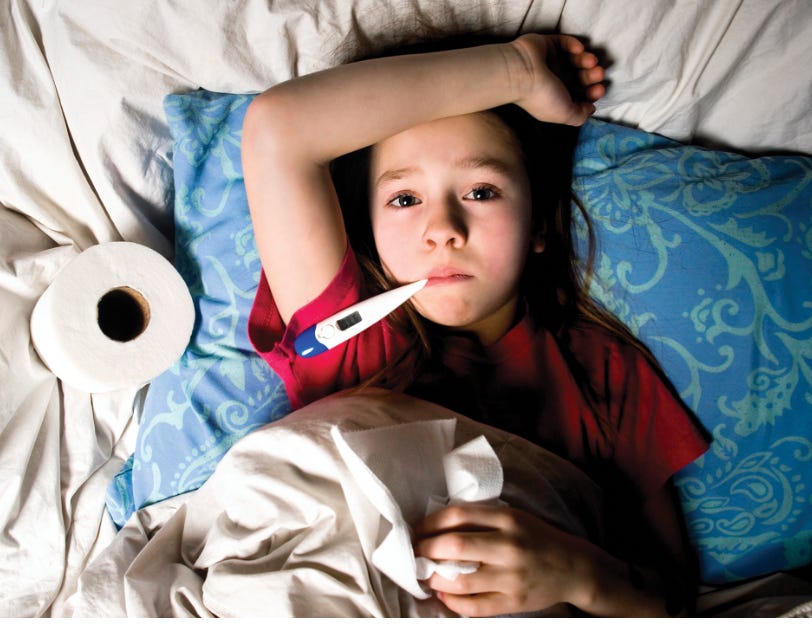
When I was a kid back in the early nineteen hundred and seventies, staying home from school because you were “sick” wasn’t an endeavor I took on lightly.
It took planning.
Days.
Sometimes even weeks.
My mother was, and still is, a woman to be reckoned with.
She was raising two kids on her own while working a full-time job in an era when men got paid twice as much simply because being able to stand while urinating meant you were worth more.
This was also when a pat on a woman’s behind from the boss was the universally accepted way of him communicating that you were doing a fine job.
Suffice it to say, it made her BS radar highly sensitive.
If you thought waking up and deciding willy-nilly that you just didn’t feel like going to school that day was gonna fly, you wouldn’t have lasted long in my house.
No.
This took meticulous planning.
And it often started with the TV Guide.
For anyone unfamiliar with this ancient document, the TV Guide was a little paperback that showed up in the mail every week and told you what was going to be on television, what channel, and what time.
And every week I’d study that thing harder than any dumb math book.
Because how was I expected to be at school learning fractions when The Three Stooges, Hogan’s Heroes, and The Big Valley were airing right there in my own living room?
The Big Valley was my favorite, and if the TV Guide listed a particularly good episode, one with Nick Barkley punching someone in the face, was coming on at ten o’clock Tuesday morning?
Well…
I might have to get sick Tuesday.
I would start slow.
Maybe I’d get a little quiet Sunday night.
That always got Mom’s attention.
I might even throw in a cough here and there.
Nothing dramatic.
Just enough to plant the seed.
By the time Tuesday morning arrived, I’d be waiting.
Lying under the covers, knowing that any minute Mom was going to come through my bedroom door and ask why I wasn’t up and getting dressed.
But I was ready.
Now remember, this was the 1970s, when there were two generally accepted household medical devices that would determine if you were sick.
One was a thermometer.
A glass one.
With mercury in it.
It would be placed under your tongue for three minutes to register your temperature, and while it sat there you’d have terrifying thoughts of somehow biting down on the glass and dying of mercury poisoning.
Raising the temperature on it was easy. You could rub the bulb of the thermometer between your fingers or against fabric, and the friction could push the mercury reading up before you handed it to Mom.
You could also hold it near a lightbulb or lamp, but you had to be careful.
If you were aiming for a believable 101°F and overshot it with a 135°F while somehow not actually being dead, the jig was up.
Besides, Mom was wise to me by then and would stand there the entire time it was in my mouth, making sure I wasn’t up to something.
The other medical instrument was more sophisticated, accurate, and much harder to deceive.
It was Mom’s hand.
Particularly, the back of it.
She’d hold it to my forehead and ask the one question that would determine if I was going to be sitting on the couch at 10 a.m. eating Cheez-Its and watching The Big Valley, or sitting in Mr. Bone’s history class struggling to stay awake.
And that question was:
“How do you feel?”
This was tricky, because if the back of her hand wasn’t buying what I was selling and the thermometer wasn’t cooperating, I had a Plan B.
“My stomach hurts.”
Checkmate.
Neither Mom’s hand nor the thermometer could disprove my stomach ache.
I had found the loophole in 1970s medical technology.
Regardless, sometimes it worked. Most of the time it didn’t.
Fast-forward to 2026 and things are a little different.
Growing up, my vitals were only read by my doctor once a year at my annual physical.
Today?
I can buy a blood pressure monitor at any CVS, a pulse oximeter on Amazon, a continuous glucose monitor at Walgreens, and a little device that will record my heart rhythm while I sit on the toilet.
For a few hundred bucks, I can buy a ring that monitors me while I sleep.
A watch that takes an ECG and can call 911 if I need it to.
A wristband that tracks my heart rate, heart rate variability, blood oxygen, respiratory rate, stress, sleep, recovery, and something called my “metabolic capacity,” which I still have no idea what the hell that is.
It even tells me if I’m aging backwards, which is great because I have some unfinished business with a waitress in 1986 who watched me order twelve coffees instead of asking her out.
Evidently, sometime in the last fifty years, we all became our own outpatient clinics.
And unlike my mother, who would ask the all-important question,“How do you feel?”, these devices instead tell me how I’m feeling.
And apparently my BS detector isn’t nearly as finely tuned as my mother’s, because I immediately believe them.
I can wake up thinking I slept pretty well.
I feel upbeat.
Coffee’s brewing.
Life is good.
Then I open the app.
Sleep Score: 72.
Oh.
I guess I feel terrible.
My shoulders slump and now I’m thinking I should sit down and sip a Vitaminwater.
The next morning I wake up positive that I slept horribly.
Tossed and turned all night.
Eyes swollen.
I stagger into the kitchen like a zombie.
Open the app.
Sleep Score: 93. Excellent.
Huh.
Suddenly my chest is flexing and I’m thinking today might be the day I start writing that novel.
And this is confusing enough when you’re only wearing one.
But me?
I wear two.
Because of course I do.
And this is where things get interesting.
I wear an Oura Ring and something called a Hume Band, and I’ve discovered they’re like two friends with completely opposite personalities who can never agree on anything.
My Oura Ring is the more reserved of the two, while Hume seems to want to tell me whatever it thinks I want to hear.
If Oura says I slept “Adequate,” Hume will immediately counter with congratulations for an “optimal night of sleep.”
It’s like if a woman asked Oura about me.
“Renny? He’s a fairly decent guy. Has a stable job. A creative side. At times, can be a little self-absorbed.”
Hume overhears the conversation.
“Wait, are you guys talking about Renny Madlena? Three-time Academy Award winner, currently being considered as the next James Bond, THAT Renny Madlena?”
And it’s not just sleep information.
At any given moment, I can check my blood pressure, how much stress I’ve been under, or how steadily I breathed last night.
And then there’s HRV.
HRV stands for Heart Rate Variability, and until I started wearing these things I had absolutely no idea it existed.
And you know what?
I was better off.
Basically, it measures the tiny variations in time between your heartbeats and, somehow, this number has become another way of determining whether I’m thriving or should probably lie down.
Mine tends to run low.
And because my wearables like to constantly remind me of this, now I can’t un-know it.
And that’s the problem with all this information.
Fifty years ago, I was manipulating a thermometer so I could stay home from school and watch television all day.
Now I’m in Safeway looking at bananas and wondering if eating one will improve the milliseconds between my heartbeats.
I mean, how did anyone function before we knew this stuff?
Imagine a couple of farmers in Maine having coffee before heading out to the fields.
“You hear about Ted?”
“No.”
“Taking a few days off.”
“Oh?”
“Ayuh… HRV’s down.”
“That’s too bad. Good man, Ted.”
“Ayuh.”
Long pause.
“Was.”
At what point does knowing more about ourselves stop making us healthier and start making us neurotic?
Before wearables:
Wake up.
“Meh, slept like crap.”
Gets coffee. Continues being a person.
Now:
5:12 a.m.
Eyes open.
How do I feel?
Doesn’t matter.
What does The Ring say?
I slowly reach toward the nightstand like I’m defusing a bomb.
Open Oura.
Loading…
Loading…
SLEEP SCORE: 87
Thank God.
I exhale. Wipe the sweat from my forehead. Hug my family.
We’re going to make it.
Next morning:
SLEEP SCORE: 71
Camera slowly pulls away from the house.
Birds scatter from the trees.
On the distant horizon…
Mushroom cloud.
Maybe Mom had it right all along.
No sleep scores. No readiness scores. No HRV.
Just the back of her hand on my forehead and one question.
“How do you feel?”
Maybe that’s the one metric that should still matter the most.
But then again, I was lying to Mom about my stomach ache so I could watch The Big Valley.
Maybe I need The Ring after all.
When you were on about the thermometer, I was thinking how did he not understand the gloriously unmeasurable stomach ache? Nice recovery. You’re insane with gadgets, though. I don’t get it. You’re probably the most physically able 71-year-old I’ve ever known.
Will someone give this man a syndicated column already?! One that bridges the realms of "Entertainment," "Opinion," and Lifestyle/Advice"?! Seriously.
This was a delight, Renny. So, so funny, and with TV show points-of-reference that gave me a warm feeling.